

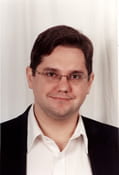
Professor
Digital Signal Processing, and Computer Systems and Software
Affiliations
A Few of My More Minor Webpages
- Setting Up an OS X Mac with The Usual Suspects
- Old page on a DARPA-funded Passive Radar project from my UIUC days (no longer actively maintained, kept up for archival purposes)
- Pattern Theoretic ATR Page (sponsored by AFOSR)
- Jason Dixon
- Ryan Palkki
- John Wilcher
- Michael Lee
- Jeong Hwan Bang
- Dr. Kerkil Choi (Fall 2005) (now Lead Scientist at General Electric Global Research Center)
- Dr. Lisa Ehrman (Fall 2005) (now Senior Research Engineer at Georgia Tech Research Institute)
- Dr. Will Leven (now with Texas Instruments) (Spring 2006)
- Dr. Martin Tobias (now with M.I.T. Lincoln Laboratory) (Spring 2006)
- Boris Beauvais (from Georgia Tech Lorraine/SUPELEC) (now with MBDA Missile Systems)
- Linda Fomundam
- Chinmay Hegde (now with Northrop Grumman)
- Sujay Joshi (M.S., Spring 2007) (now with Lockheed Martin)
- Jonathan Morris (now with MITRE)
- Bill Overton
- Cody Wortham (M.S., Spring 2007) (now with GTRI)
- I held the Demetrius T. Paris Junior Professorship, a special chair for the development of young faculty, from 2004-2007.
- Postdoctoral Research Associate (Aug. 1998 to Aug. 2001)
Visiting Assistant Professor (Aug. 2000 to Aug. 2002)
Univ. of Illinois at Urbana Champaign
Coordinated Science Laboratory
Project: Design and Optimization of Passive and Active Imaging Radar, focusing on detection, tracking, imaging, and identification of aircraft via reflected commercial television and FM radio signals.
Faculty: Richard Blahut, Yoram Bresler, Weng Chew, Pierre Moulin, David Munson - My wife and I sang in the Dekalb Choral Guild from Fall 2002 to Fall 2007.
- Night Times was a St. Louis based music magazine which I was involved with for three years as a writer, photographer, typesetter, and eventually managing editor. The printed version I was involved with closed up shop in 1998, but founding editor Julia Gordon has brought it back in an on-line version.
Research
Overall Interests: Statistical signal processing, Grenander’s pattern theory
Applied Research: Radar systems, target tracking, image reconstruction, automatic target recognition
Other Interests: Music synthesis, information theory, radio astronomy, crystallography
Current Students
Former Students
Previous Positions
Education (Washington Univ. in St. Louis)
Graduate: M.S. (May 1995) and D.Sc. (Aug. 1998) in Electrical Engineering
Advisors: Profs. Michael Miller and Donald Snyder.
I worked in the Electronic Systems and Signals Research Laboratory. My graduate work focused on applying Grenander’s pattern theory to automatic target recognition in infrared scenes. Most of this work was funded by the U.S. Army Center for Imaging Science.
Undergraduate: Triple major in computer science, electrical engineering, and music (May 1993). As a music major, I focused on theory and composition.
Coordinates
School of Electrical and Computer Engineering
Georgia Institute of Technology
Mail Code 0250
Atlanta, GA 30332
Voice: 404-385-2548
Fax: 404-894-8363
E-mail: lanterma/at/ece/dot/gatech/dot/edu (remove slashes, change “at” and “dot” to appropriate punctuation – at this point it’s probably pointless for me to try fighting the spambots, but I might as well try!)
Office: Van Leer W431 (I am not often there, so I do not recommend trying to “drop by” to find me; e-mail is the best way to reach me.)
Assorted Activities and Fun Stuff
Last modified 1/8/2018. Comments or questions to my e-mail above.